
From maple syrup to European vineyards, from trade flows to student journeys: an alliance can also be measured by the experiences it makes possible.
Written by Megane Sagnon, Ottawa, October 30, 2026
Introduction — A world connected by more than trade
Imagine Québec maple syrup on a breakfast table in France. A Canadian student discovering the narrow streets of Seville or the canals of Venice. A European family crossing the Atlantic to see Niagara Falls. These images may sound like travel writing, but they also tell an economic story: products crossing borders, jobs supported by visitors, expertise moving between markets and skills developed through cultural exchange.
On October 29-30, 2026, Montréal hosts the Canada–European Union summit. Leaders are expected to discuss trade, critical raw materials, technology, research, education and people-to-people cooperation. As this article is written, the meeting’s conclusions remain unconfirmed. Yet one question goes beyond diplomatic statements: what could closer ties mean for the next generation’s education, careers and experience of the world?
1. From maple syrup to French wine: the value of know-how
Maple syrup is more than a Canadian symbol; it is an export product. Statistics Canada reports that in 2023, 26.5% of Canadian maple syrup exports worth C$163.4 million went to 30 European countries. Germany led the European market at C$47.8 million, followed by France at C$31.6 million and the United Kingdom at C$30.2 million. The differences show that “the European market” is not one uniform block: demand, distribution networks and consumption habits vary by country.
Why does a product associated with Québec’s forests find its way onto European tables? Quality alone is not enough. Exporters must maintain reliable supply, choose the right distributors, explain how the product can be used, build a brand and manage transport and compliance costs. French wine follows a comparable logic, although its appellations, history and value chains are different. In both cases, a local product becomes international through a mix of reputation, logistics and consumer knowledge.
The Comprehensive Economic and Trade Agreement (CETA), provisionally applied since 2017, has removed or reduced many tariff barriers. In 2025, Canada–EU trade in goods and services reached about C$178.6 billion. Bilateral merchandise trade grew 77% between 2016 and 2025. That increase reflects a broader relationship and cannot be credited to the agreement alone: prices, economic conditions, investment and business decisions also matter. (Global Affairs Canada, 2026)
The maple-syrup case illustrates a key limit of trade agreements: opening a door does not guarantee that every business can walk through it. Smaller firms may lack capital, commercial contacts or the resources to understand regulations and build a presence abroad. For them, access to information, financing and distribution networks can matter as much as tariffs.
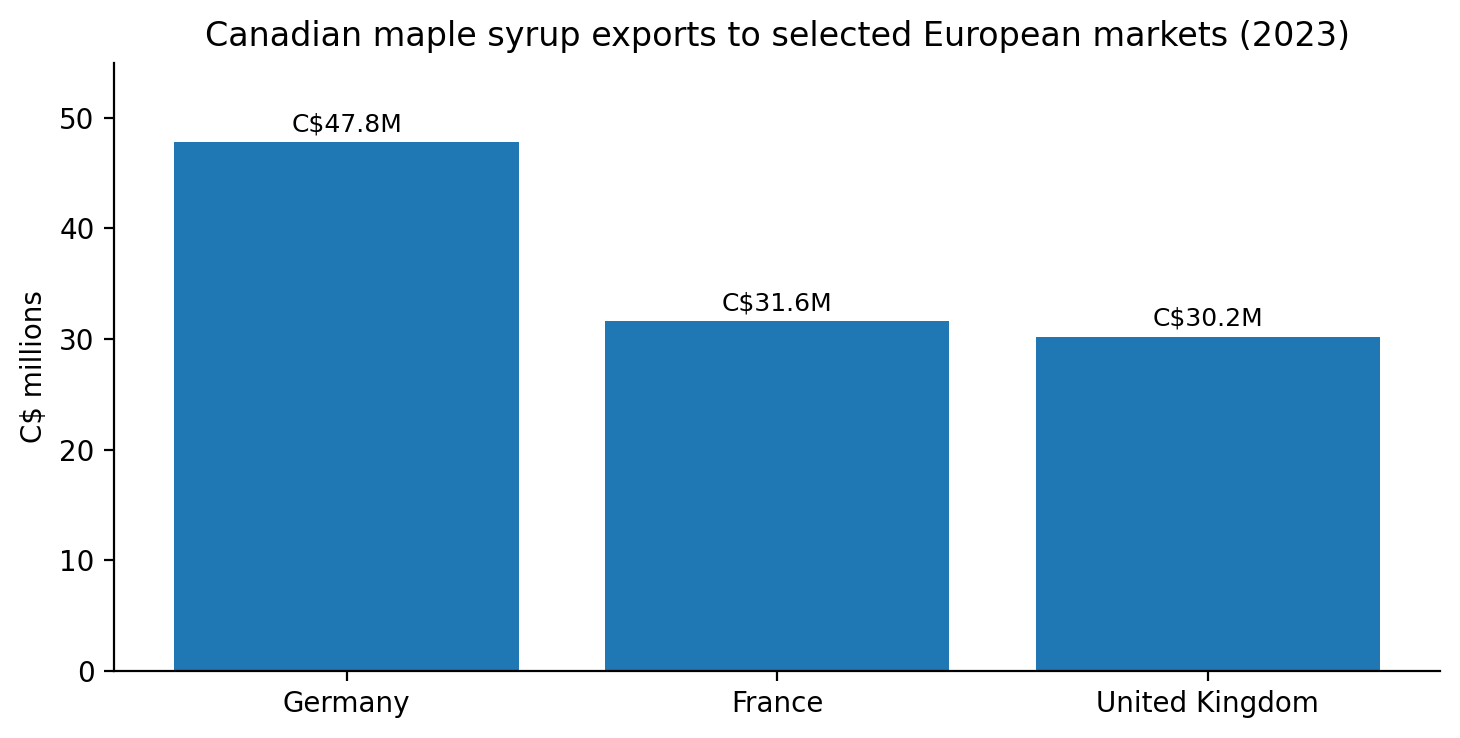
Source: Statistics Canada; 2023 values in Canadian dollars.
2. From Venice to Seville and Niagara Falls: tourism as exchange
In Venice, canals, palaces and narrow streets draw visitors from around the world. In Seville, architecture, food and cultural life shape the city’s appeal. These destinations remind us that economies are not built on goods alone: tourism supports accommodation, restaurants, transport, shops, museums and cultural occupations. It also raises difficult questions about pressure on housing, infrastructure and residents’ quality of life.
The same principle applies in Canada. Niagara Falls is an iconic landscape, but also an economic hub for hotels, restaurants, guides, retailers and transport services. Visitors generate spending, while destinations must invest in infrastructure and manage the environmental and social effects of tourism.
These places are not all directly connected to decisions made at the summit. Rather, they illustrate what international exchange makes possible: the movement of people, spending, ideas and cultural practices. For young people, travel can build language and intercultural skills that matter to companies serving international customers or working with overseas partners.
3. From student exchanges to international careers
Student mobility is one of the most direct ways to turn international relations into personal experience. A Canada–EU Joint Cooperation Committee report covering March 2023 to February 2025 recorded 587 planned student and staff mobilities from Canada to Erasmus+ countries and 485 in the opposite direction for the 2022–23 academic year. Between 2021 and 2024, 125 Canadian students received Erasmus Mundus Joint Master scholarships. (Canada–EU Joint Cooperation Committee, 2025)
These figures demonstrate existing cooperation, but they do not mean Canada has become a full participant in Erasmus+. Broader Canadian participation has been raised as a possible way to expand mobility opportunities; its terms and funding still need to be confirmed. The University of Ottawa already offers selected Erasmus+ mobility opportunities with partner institutions, while the Telfer School of Management maintains international partnerships. Eligibility varies by programme and institution, so students should check the conditions that apply to their degree.
A semester abroad is more than a line on a résumé. It can teach a business student to work in a different regulatory environment, communicate across cultural differences and understand how companies adapt products to different markets. But mobility remains unevenly accessible: housing costs, visas, course requirements and funding can limit participation. An ambitious partnership should also be judged by how accessible its programmes really are.
4. Who actually benefits from closer ties?
Aggregate trade figures can make it seem as though everyone benefits in the same way. That is not automatic. A large company may have legal, tax and logistics teams ready to take advantage of new market access; a small firm may lack the resources. Workers may benefit from new contracts, but can also face changing competition or working conditions. Students with money and flexibility can more easily study abroad than those who must work, care for relatives or complete mandatory courses.
The same question applies to resource-producing regions. Higher exports may support economic activity, but long-term benefits also depend on local jobs, training, processing and environmental consequences. The impact cannot be reduced to the value of trade: we need to ask who captures the value, where it is created and what costs communities bear.
To evaluate the partnership, policymakers should track not only trade volumes but also SME participation, job quality, investment in local processing, access to mobility programmes and how benefits are distributed across regions and social groups.
5. Critical minerals: an alliance focused on the future
Beyond iconic landscapes and products lie the raw materials powering tomorrow’s economy. Lithium, nickel, cobalt, graphite and other minerals are essential to many batteries, clean technologies and digital applications. Canada has resources that could contribute to Europe’s supply security; Europe brings research, processing capacity and a significant market.
Statistics Canada reports that Canadian critical-mineral production contributed C$26.3 billion to nominal GDP in 2024 and was associated with 57,473 jobs. Between 2019 and 2024, nominal GDP associated with production rose 42.3%, while real GDP grew only 2.3%. The gap is a reminder that commodity prices strongly influence nominal value: a rise in current-dollar value does not mean an equivalent increase in physical output. In 2024, real GDP from this production did grow by 8.2%. (Statistics Canada, 2026)
This question extends beyond North America. In the Sahel, Burkina Faso relies heavily on gold in its exports, while Niger is notably associated with uranium production. These trajectories raise a question shared by resource-rich countries: how much value is captured locally, and how much related activity processing, specialized services, training and skilled employment stays in the country? The political and economic contexts and the resources involved differ, so these cases should not be treated as equivalent. They do, however, underline that mineral wealth does not automatically translate into broadly shared prosperity.
The strategic question is whether Canada will mainly extract and export raw materials or also develop refining, processing, component manufacturing and recycling. Higher-value activities can create skilled jobs, but they require investment, infrastructure, expertise, permits and credible environmental standards. Projects must also account for affected communities and ecosystem impacts.
The question of locally captured value also resonates in the Sahel. In Burkina Faso, gold accounted for about 77% of exports, 16% of GDP and 22% of government revenue in 2023, according to the World Bank. In Niger, uranium represented between 15% and 20% of exports from 2017 to 2023, before trade and mining disruptions in 2024 sharply altered those flows. These trajectories are not identical to Canada’s and do not arise from the same political context. They nevertheless raise a shared question for resource-rich economies: how can global demand be turned into skilled jobs, local capabilities and sustainable processing activities rather than dependence on commodity prices and external buyers? (The World Bank, 2024)
Potential career opportunities extend beyond mining. Finance and accounting can help assess projects; audit and compliance can examine controls, risks and disclosure obligations; logistics can secure supply chains; and data analysis can track costs and emissions. These opportunities are conditional: they depend on which projects are funded and which jobs are created.
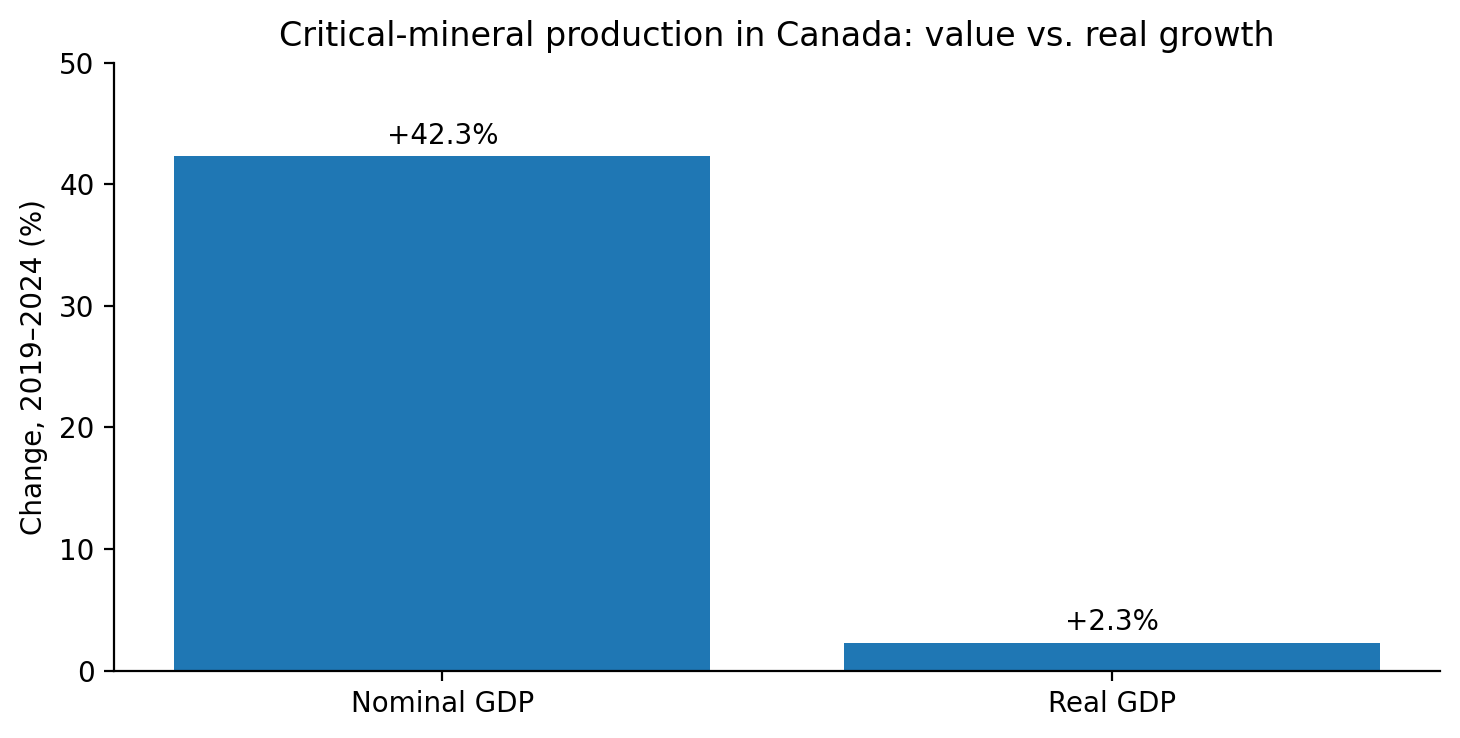
Source: Statistics Canada. Nominal growth also reflects price changes; it does not by itself measure growth in production volumes.
6. From trade to skills: what could the jobs look like?
The link between geopolitics and a first job can seem distant. It becomes more concrete when we follow the tasks that make cross-border business possible. A company selling maple syrup in Europe needs sales forecasting, inventory management, customs compliance and margin analysis. A critical-minerals project may need financing, internal controls, risk management, supplier audits and sustainability analysis. A tourism destination relies on marketing, pricing, languages, visitor data and infrastructure management.
For an accounting student, that could mean auditing a Canadian exporter, examining foreign-exchange exposure and controls at a company operating in Europe, analyzing financing for a mining project or checking the traceability of spending tied to environmental commitments. International relations do not automatically create these jobs, but they shape the skills sought by organizations operating across borders.
Conclusion — Turning a partnership into lived experience
From maple syrup exported to Europe to visitors discovering Niagara, from university partnerships to critical-mineral supply chains, Canada–Europe relations operate on several levels: in the products we consume, the cities we visit, the education we pursue and the careers we choose.
The October summit could deepen these connections, but stated ambitions must be distinguished from commitments actually adopted. The partnership’s success will not be measured only in billions traded. It will also depend on local value creation, environmental responsibility, job quality, the place of small businesses and young people’s real access to mobility and training.
Ultimately, an economic alliance becomes meaningful when it stops being abstract. It becomes visible in a product reaching a new market, a city welcoming visitors, a student gaining new skills or a graduate discovering a career path they had never considered.
References
Canada–EU Joint Cooperation Committee. (2025). Joint Cooperation Committee report on the state of the EU-Canada relationship (March 2023 to February 2025). https://international.canada.ca/en/global-affairs/corporate/reports/eu-jcc-2023-2025
Global Affairs Canada. (2026). Canada and the European Union. https://www.international.gc.ca/world-monde/international_relations-relations_internationales/eu-ue/index.aspx?lang=eng
Statistics Canada. (2024). Maple syrup: Canada’s gift to the world. https://www.statcan.gc.ca/o1/en/plus/7493-maple-syrup-canadas-gift-world
Statistics Canada. (2026, October 8). Economic contribution of critical mineral production in Canada, 2024. The Daily. https://www150.statcan.gc.ca/n1/daily-quotidien/261008/dq261008a-eng.htm
World Bank. (2024). Burkina Faso economic update: April 2024. https://documents1.worldbank.org/curated/en/099062424155074203/pdf/P500480102834c0fd1a8dc122e6e4891bbd.pdf
World Bank. (2025). Niger economic and poverty update.