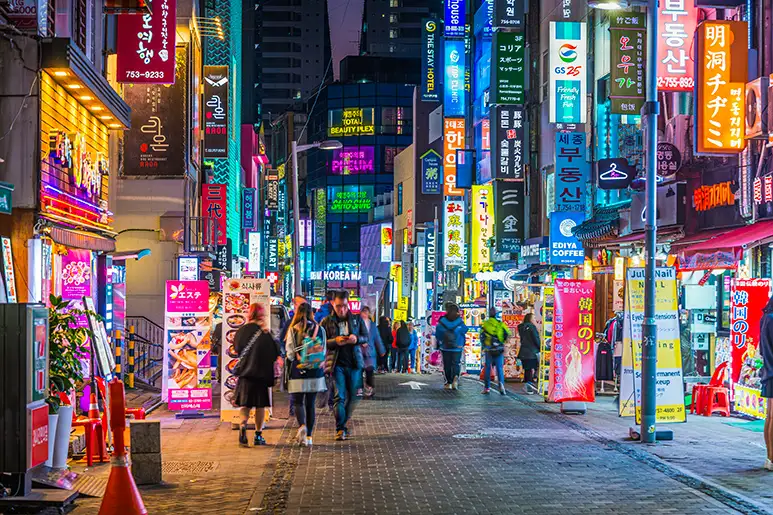
Today, beauty brands like Cosrx and music icons like BTS have monopolized global pop culture, along with action-packed dramas like Squid Game and the niche appeal of ASMR Mukbang. However, it hasn’t always been this way. South Korean entertainment has taken the world by storm in recent decades, with more and more consumers embracing the nation’s unmatched creative output. This article will dive into the fascinating history of the Korean Wave (pun intended!) and its modern-day influence on the universal perception of East Asian entertainment.
The Hallyu Wave as a Global Phenomenon
What is Hallyu? Quite literally, it translates to “the Wave of Korea.” This refers to the international commodification and expansion of South Korean media, games, technology, beauty, fashion, lifestyle, tourism, and cuisine. The 1997 Asian financial crisis left a devastating impact on South Korea, pushing the country to drastically restructure its economy. Following this, the government resorted to investing in culture as an export, releasing cheaper but higher quality content that quickly replaced expensive Japanese media in other Asian countries. This laid the foundation for the global dominance of Korean pop culture.
In 2012, a single released by a prominent South Korean rapper and songwriter rose to international fame, evolving into an inescapable global anthem heard in everything from grocery stores and shopping malls to fitness studios and simulation games. That song was Gangnam Style by PSY. It shattered records as the first-ever K-Pop song and highest charting Korean song to appear on the Billboard Hot 100, peaking at #2. Its impact was so sensational that it is now immortalized by a bronze statue of its signature hand choreography in Seoul’s very own Gangnam District. The popularization of this iconic track is widely credited with paving the way for the globalization of future K-Pop songs and artists.
Gradually, K-Pop turned into a distinct musical genre beloved by fans around the world, transcending language. It represents much more than a mere export; it has become a self-contained culture with its own terminology, using words such as “maknae” to describe a band’s youngest member. While K-Pop idols share the Western tradition of dedicated fandom names, they often maintain a more intimate connection with their communities. This is fostered through frequent appearances on variety shows and a collector culture centered on photocards, lightsticks, and fanchants, creating a concert experience and level of fan engagement rarely seen in Western media. Through the combination of music, media, and merchandise, K-Pop has breached a new dimension of interaction between artist and admirer.
Redefining Representation at the Crest
The unique blend of music production, dance choreography, and videography that is K-Pop is far from the only element of South Korean entertainment. Korean cinema has seen a massive surge in popularity since the 2000s, most notably shown by the award-winning 2019 film Parasite. This blockbuster illustrates intersectionality by exploring class disparity through the lens of Korean families, moving the conversation beyond basic visibility. The rise of Hallyu has not only introduced the world to a diverse array of South Korean cultural influences, but it has also opened the eyes of billions to on-screen East Asian representation as a whole, from beauty and cosmetic advertisements to hit movies and TV series.
Since the rise of Korean media, the portrayal of East Asians on the big screen has become significantly more nuanced. This shift has challenged overused Hollywood tropes such as the stoic, the kung fu master, or the academic punchline while working to dismantle the repeated objectification of Asian women. By leveraging soft power diplomacy and market branding, South Korea has moved past its past reputation as a nation defined by military tension. In the decades following the 1997 financial crisis, the world’s perception of Korean television has shifted from one of conflict and conglomerates to a vibrant, multifaceted manifestation of the fact that Asian people are not a monolith. It is crucial to note that this success does not represent a form of cultural imperialism; rather, Hallyu has cultivated a sense of cultural solidarity across Chinese, Taiwanese, Japanese, Macanese, Mongolian, and Southeast/Central Asian communities that is simply irreproducible.
The Hallyu Wave has capitalized on the principle of familiarity bias, which is the idea that consumers are more likely to invest in a product or service if they’ve seen it before and have grown accustomed to it. This phenomenon creates a self-sustaining cycle: the continued references to specific fashion brands or beauty products within K-Pop music videos and K-dramas drives consumer demand for those goods. As viewers become increasingly exposed to these cultural exports, they enter a feedback loop where the consumption of media continuously incites interest in Korean supply, further strengthening the nation's leadership in the global marketplace.
Navigating the Hidden Troughs of K-Pop
Like all good things, the Korean entertainment industry, and the K-Pop industry in particular, has a dark side that is rarely discussed outside of its most active circles. At its forefront is its staggering human cost. On the daily, idols are subject to sasaeng fans, extreme beauty standards, and an overbearing pressure from their labels to maintain the perfect image. These factors reinforce K-Pop's reputation for toxic fan culture, driven by both overly obsessive supporters and companies that value its bottom line over the physical and emotional well-being of its artists. Furthermore, the industry is notorious for its normalization of bullying, sexual exploitation, drug abuse, and even suicide, with idols too often taking the fall for these systemic failures. These issues are compounded by the fact that South Korea remains a socially conservative state, criticized for its deep-seated queerphobic attitudes and legislation, as well as widespread racism and xenophobia.
This ties into the appropriation debate within K-Pop, which addresses the hidden truth that much of the industry is heavily indebted to Black culture. As seen through numerous scandals over the years, there is a fine line between cultural appreciation— respecting and learning from the roots of Hip-Hop and Jazz— and appropriation, where elements of Black identity are adopted as a costume without proper credit. Many artists and stylists have faced backlash for “borrowing” sacred hairstyles, such as afros or dreadlocks, or for the shameful use of blackface. This trend of aesthetic commodification is not limited to Black culture; it extends to the appropriation of Indigenous American and Southeast Asian cultural symbols as well.
Ultimately, while the K-Pop industry possesses immense potential for growth, such fundamental change does not happen overnight. It requires a collective effort from fans, artists, and corporations alike to foster a culture of accountability and advocate for systemic reform. It is the duty of every stakeholder in the international Hallyu community to educate themselves on the complexities of an industry that is not always as polished as it is marketed to be. Acknowledging the steady progress made, one Black K-Pop enthusiast writes: “The community now needs to continue moving forward and promoting cultural appreciation and awareness.”
As it stands today, the Hallyu Wave shows no signs of receding, and it is evolving from a regional export to an unprecedented global superpower. While the industry navigates the "troughs" of ethical reform, its "crest" reaches new heights through groundbreaking projects like the recent animated feature film KPop Demon Hunters and the rise of global groups like XG and KATSEYE. By debuting members from diverse ethnic and national backgrounds, these groups prove that the Hallyu framework has moved beyond Korean borders to become a universal blueprint. It is clear the world has caught the fever, but to truly ride the wave for generations to come, the South Korean entertainment industry must strike a balance between artistic innovation and moral integrity.
References
Abejo, M. (2022, March 16). K-Weekly: Black appropriation in K-pop (Part 1). The Tufts Daily. https://www.tuftsdaily.com/article/2022/03/k-weekly-black-appropriation-in-k-pop-part-1
Ali, S. (2023, August 17). Asian characters with speaking roles in Hollywood jumped dramatically in last 15 years. NBC News. https://www.nbcnews.com/news/asian-america/asian-characters-speaking-roles-hollywood-jumped-dramatically-last-15-rcna100478
Billboard. (2025, January 21). Every Non-English-Language Song to Reach the Top 10 of the Billboard Hot 100. https://www.billboard.com/lists/non-english-songs-hot-100-top/los-lobos-la-bamba/
Kim, Bok-rae. (2015, October). Past, Present and Future of Hallyu (Korean Wave). American International Journal of Contemporary Research, 5(5), 154–160. https://aijcr.thebrpi.org/journals/Vol_5_No_5_October_2015/19.pdf
MSNBC. (2022, February 24). Hallyu Explained | The reason Korean culture is taking over the world | This Is Why [Video]. YouTube. https://www.youtube.com/watch?v=CmkULRHGa40
Roll, M. (2021, October). Korean Wave (Hallyu) - The Rise of Korea's Cultural Economy & Pop Culture. Martin Roll. https://martinroll.com/resources/articles/asia/korean-wave-hallyu-the-rise-of-koreas-cultural-economy-pop-culture/
Smithsonian Ocean. (2020, August). The Anatomy of a Wave. https://ocean.si.edu/planet-ocean/waves-storms-tsunamis/anatomy-wave