If you’re Gen Z, the term “Y2K” probably brings to mind something completely different than it did 26 years ago. Today, it might spark images of low-rise jeans, metallic handbags, flip phones, or the glossy futuristic nostalgia that has taken over social media. The “Y2K aesthetic” has become a cultural shorthand for early-2000s fashion and pop culture.
But originally, Y2K was neither a trend nor a vibe, but a deadline.
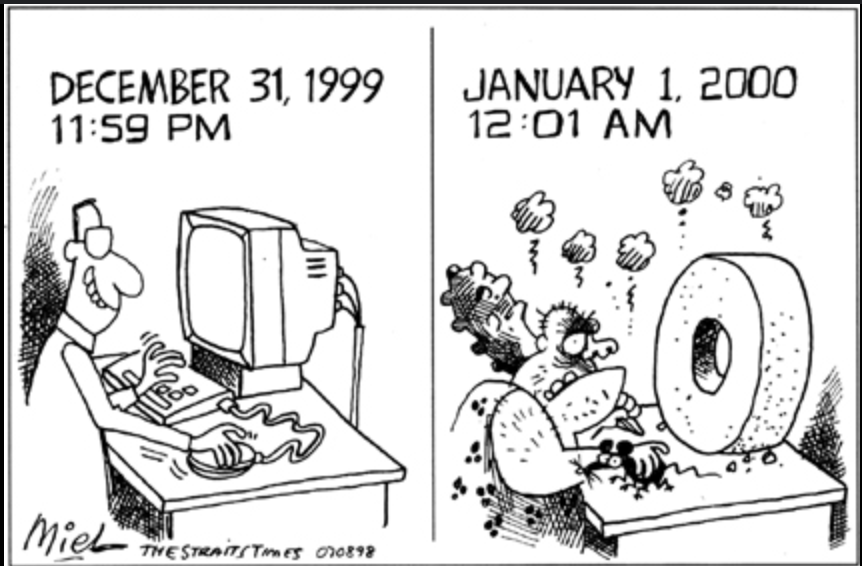
At the very start of Y2K, in its most literal sense, the term referred to a looming technological crisis: what would happen when the world’s computers attempted to enter the year 2000. For a period of time, people genuinely weren’t sure society would make it through January 1st without serious disruption.
Y2K stands for “Year 2000,” and the problem came from a surprisingly simple programming shortcut. For decades, many computer systems stored years using only two digits instead of four. 1989 was just '89', 1970 was just '70', and so on. It was efficient at the time, but it created a major issue as the century came to a close. When the calendar rolled over from 1999 to 2000, computers would register the year as “00,” and many systems could interpret that as 1900, not 2000.
It wasn't necessarily the sudden shutdown of computers that was a concern. It was feared that time itself would appear incorrectly, causing computers to make disastrous errors. Companies could lose decades' worth of records, banks could miscalculate interest, airlines could lose scheduling information, and hospitals could have equipment failures. As the modern world grew more reliant on digital infrastructure, Y2K revealed how brittle that infrastructure could be.
Now that January 1st, 2000 has come and nothing apocalyptic has occurred, it is easy to laugh. However, that is the exact reason why Y2K is still significant today. The reason it didn’t happen is because the world worked relentlessly to prevent it.
Companies, governments, and IT departments rushed for years to replace infrastructure, audit out-of-date systems, rewrite millions of lines of code, and create emergency backups. And the cherry on top? The time crunch - it’s not like the year 2000 could have been postponed!
There might have been serious repercussions if systems hadn't been fixed. There was a real risk of operational paralysis, economic disruption, and a breakdown in confidence in the digital systems that were starting to form the foundation of contemporary life. Businesses still struggle with the world's dependence on technology, and most people don't fully comprehend it until it breaks, which is why Y2K was significant.
Soooo… marketing?
The fact that Y2K was more than just a technological problem adds to its allure. Additionally, it was among the biggest sales opportunities in the history of the tech sector. Demand arises from uncertainty, and Y2K generated uncertainty on a worldwide level.
Y2K marketing rewrote marketing as a matter of comfort, something it was never thought to be in a world of gaudy branding. Tech companies were selling more than just goods; they were selling survival, continuity, and safety. Customers weren't inquiring about the least expensive option, but wanted to know which business could ensure that their systems wouldn't fail. Reputation replaced innovation, and trust replaced price.
Did Y2K Help Shape Modern Marketing as We Know It?
Although Y2K is primarily remembered as a technological crisis, it also subtly changed the way companies promoted intricate, risky solutions. The Year 2000 issue paved the way for a number of marketing techniques that are still widely used in the tech sector today.
The development of what is now known as B2B solution marketing was accelerated by Y2K. Businesses were marketing long-term stability, knowledge, and protection rather than a single product. Marketing shifted from ostentatious consumer-style promotion to consulting-driven, trust-building messaging as a result of the crisis. This same approach is still used by many of the biggest enterprise technology companies in the market today, with companies presenting themselves as partners in risk management rather than as sellers.
The normalization of preventive spending and the growth of "crisis marketing" had another long-lasting effect. Because of Y2K, it became normal, nay expected, for businesses to spend huge sums of money trying to stop something that hadn't happened yet. In today's markets, where companies invest heavily in threats like data breaches and infrastructure failures that are invisible until they happen, that reasoning has become fundamental.
Most significantly, Y2K strengthened the importance of credibility. One of the key features of contemporary enterprise marketing is still its emphasis on brand authority.
Was Marketing a Crucial Component of Getting Past the Crisis?
There was more to marketing than Y2K's aftereffects. The majority of business executives were not fully aware of the coding issue at the heart of the highly technical problem. In order to turn an intangible technological risk into a tangible business priority, marketing was essential. Many organizations might not have moved swiftly enough without that translation.
Large-scale awareness was raised by marketing. Executives, governments, and industries were able to identify the possible repercussions before it was too late thanks to its messaging. In this sense, marketing served as a conduit for information between decision-makers and technical specialists.
It inspired action as well. Massive workforce commitment, funding, and coordination were needed for the global response. Businesses had to prioritize technology upgrades, approve emergency contracts, and defend budgets. Public worry increased as 2000 drew near. Companies required assurance that infrastructure would be solid, banks would operate, and airplanes would fly, and marketing acted as crisis management through messaging and communication.
Y2K marketing was, in many respects, not about persuading in the conventional sense. It was about confidence, clarity, and readiness. It made certain that businesses viewed the issue seriously enough to take action, and that they did so quickly enough to avert catastrophe.
The irony of Y2K is that its success is invisible. Because the crisis was largely avoided, it became easy to dismiss it as overblown. But the truth is that the combination of technical labor, corporate investment, and strategic communication is exactly what allowed the world to step into the 21st century without collapse.
From Y2K to AI: Why the Biggest Tech Markets Are Built on Uncertainty
More than two decades later, Y2K feels like a strange relic of an earlier digital age. But the business dynamics it revealed have not disappeared. In fact, they have returned in one of the most defining technological shifts of the modern era: artificial intelligence.
Today, AI occupies a similar space in the corporate imagination that Y2K once did. It is widely understood as transformative, deeply technical, and impossible to ignore, yet still not fully understood by most of the people responsible for making decisions about it. Businesses are once again facing a future shaped by systems they depend on but cannot always explain.
Companies are pouring resources into AI infrastructure, automation tools, governance frameworks, and ethical safeguards, not only because of what AI can do, but because of what might happen if they fail to adapt. Just as Y2K forced organizations to modernize outdated systems, AI is forcing organizations to rethink workflows, labor, security, and competitive advantage.
The marketing parallels are equally striking. Much like Y2K, AI is not being sold as a simple product. It is being sold as a solution to an existential business fear of falling behind. Y2K reminds us that technology-driven markets are rarely built on innovation alone. They are built on psychology, trust, deadlines, and the fear of disruption. The biggest opportunities emerge when the future feels uncertain and the cost of inaction feels catastrophic.