Artificial intelligence (AI) is no longer a thing of the future. It is here, in the present time, and for better or for worse, there is no going back. Just forward.
Although AI raises questions and concerns, such as regulations, security, hallucinations, scarcity of entry-level positions and a potential overvaluation (a.k.a the AI Bubble), it is hard to avoid it, especially in professional settings. While these concerns must be addressed, let’s discuss the advantages of utilizing AI, in celebration of Business Month here at the Telfer Business Journal.
According to Statistics Canada in the 2021 Census, 3⁄5 of Canadians are employed in an occupation that highly exposes them to AI technologies (Bryan et al.). What’s more, approximately 78% of Canadian Small and Medium-sized Enterprises (SME) are on the lookout to adopt these AI technologies in 2024 (Microsoft). However, to begin, what even is AI?
The Multiple Facets of AI
In recent years, AI has usually been synonymous with ChatGPT. Not to break the news, but AI runs much deeper. A simple definition provided by IBM reads as follows: “Artificial intelligence (AI) is technology that enables computers and machines to simulate human learning, comprehension, problem solving, decision making, creativity and autonomy.” AI uses human knowledge to power its systems, enabling it to predict trends, analyse data and identify errors by mimicking humans (Stryker and Kavlakoglu). As mentioned, AI is more than the most recent version of ChatGPT, so let’s explore some of its different dimensions.
Categories
Among AI technologies, there are three levels of capabilities, classified in categories, namely, Artificial Narrow Intelligence (ANI), Artificial General Intelligence (AGI) and Artificial Super Intelligence (ASI).
Interestingly, ANI, also known as “Weak AI”, is the only type of AI that exists in society today. Its capabilities are limited to performing single or “narrow” tasks, as it is trained to do so. For example, ChatGPT is only capable of carrying out one singular task, which is text-based chat.
The two other types of AI are deemed strong. For one, the idea behind AGI is that it would be able to accomplish new tasks without the need for humans to train it. For ASI, its model is almost out of every science-fiction movie or novel, where the AI can essentially think for itself (IBM Data and AI Team). However, no need to worry, they are both only theoretical.
Subsets
Now, keeping the types of AI in mind, specifically ANI, it is possible to see this as an umbrella term. Within it, there are “subsets,” or sub-categories of AI systems, organised based on their purpose, the primary one being “machine learning” (ML).
Precisely, ML enables optimization, such as an e-commerce platform recommending a product to a customer based on their preferences, while minimizing errors caused by mere assumptions (Crume and IBM). Despite this, it relies on human interaction to provide it with labeled data to analyse, which is called “supervised learning” due to an increased human intervention. Conversely, an “unsupervised” ML indicates it can run more freely, through unlabeled data, without human instructions (Delua).
In addition, another subset can be found in the depths of ML systems: deep learning (DL). To give a brief overview of DL, its main capacity lies in automation. The use of large sets of multilayers of neural networks, earning DL the title of “scalable machine learning,” allows it to observe patterns in unstructured data, thereby removing the need for human interaction. Still, the difficulty arises from determining how the system arrived at their results and the lack of reliability (Crume and IBM). No wonder Generative AI fits inside this subset (SAP SE Enterprise).
Lastly, there are numerous other subsets under the AI-umbrella. One of which is natural language processing (NLP), used in systems like Siri, Alexa or other virtual assistant tools, to interpret human language, and in turn, generate human-like answers (Smolic). In fact, the source cited here is Graphite Note, a machine-learning platform. All this to say, AI is fundamentally more than just ChatGPT. Understanding the layers that run deep in the AI landscape gives businesses and other sectors of activity, an advantage, and here is why.

AI Makes Business Sense
To reiterate, AI is not perfect – far from it. While it does pose plenty of justifiable concerns, the
Statistics do not lie:
● 30.6% of businesses reported having used AI in the finance and insurance industry
● 35.6% of businesses in the information and cultural industries were most likely to report
having used AI over the last 12 months, as of the second quarter of 2025 (Bryan et al.)
● 83% of small business owners planned on using AI in 2024
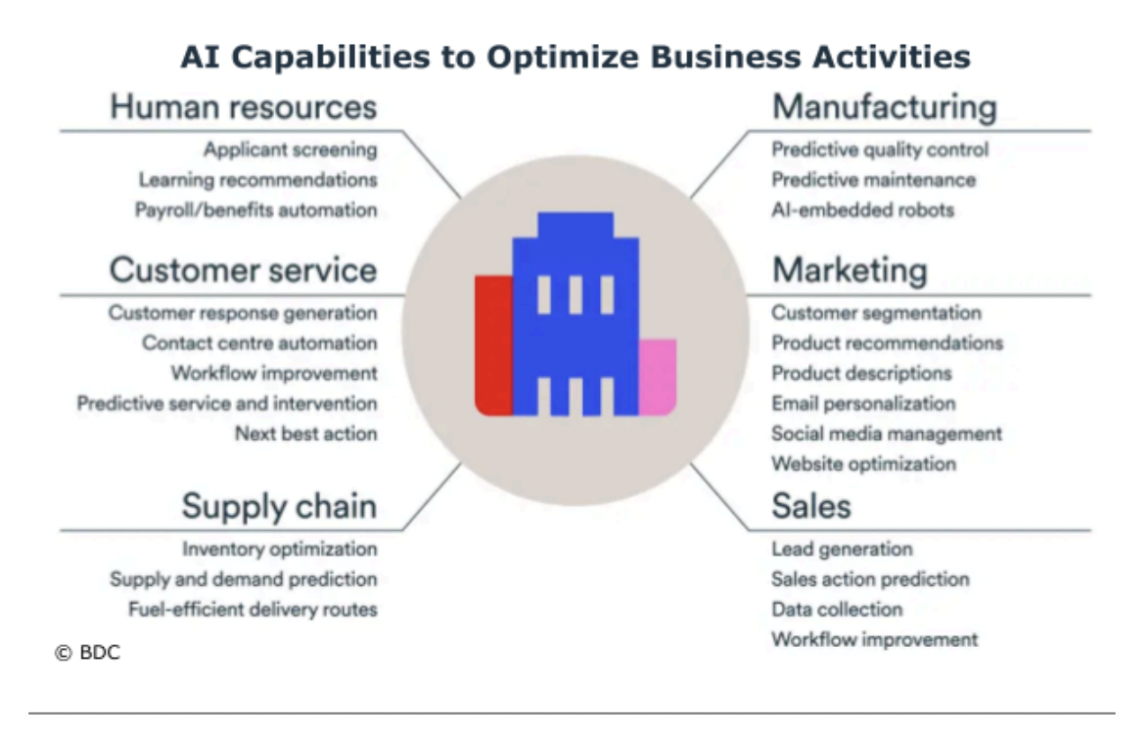
The implementation of AI in businesses offers several advantages, including increased employee productivity, reduced costs, and improved decision-making. In some cases, AI software facilitates customer relationship management (CRM), leading to more sales and marketing prospects (Bell). The faster we come to accept this, the faster we can get ahead. To draw an analogy with the printing press, invented more than 500 years ago, there was a lot of resistance, particularly from monks (Wirtz), but it also brought about a lot of opportunities. Indeed, just like with any technological innovation and invention, from airplanes to cars, society adapts to them and discovers new opportunities (Brynjolfsson and McAfee). Those who jump on the train faster will not be left behind, and can have the potential to become as well known as Ford is to us today.
Learning AI, ML and mastering their use responsibly, as students, whether in the business world or elsewhere, will give us an important competitive edge because this skill is sought after by employers and entrepreneurs alike. As we adapt more quickly, we become leaders in this field of knowledge and are able to acquire transferable skills. Moreover, it is crucial to also use our own critical thinking and ethical logic (International Business University) because, at the end of the day, AI can never replace the human brain, knowledge and empathy.
On one final note, as Simon Squibb said: “AI’s not going to take your job, but those using it will”.
PS: This article was not written by AI.
Works Cited
Bell, Elysse. “How Small Businesses Can Use AI Tools.” Investopedia,
https://www.investopedia.com/how-small-businesses-can-use-ai-tools-8609366.
Accessed 15 February 2026.
Bryan, Valerie, et al. Analysis in Brief Analysis on artificial intelligence use by businesses in
Canada, second quarter of 2025, 16 June 2025,
https://www150.statcan.gc.ca/n1/pub/11-621-m/11-621-m2025008-eng.htm. Accessed
15 February 2026.
Brynjolfsson, Erik, and Andrew McAfee. “The Business of Artificial Intelligence.” Harvard
Business Review, 18 July 2017,
https://hbr.org/2017/07/the-business-of-artificial-intelligence. Accessed 15 February
2026.
Crume, Jeff, and IBM. “AI vs. Machine Learning vs. Deep Learning vs. Neural Networks.” IBM,
https://www.ibm.com/think/topics/ai-vs-machine-learning-vs-deep-learning-vs-neural-net
works. Accessed 15 February 2026.
Delua, Julianna. “Supervised vs. Unsupervised Learning: What’s the Difference?” IBM,
https://www.ibm.com/think/topics/supervised-vs-unsupervised-learning. Accessed 15
February 2026.
IBM Data and AI Team. “Types of Artificial Intelligence.” IBM,
https://www.ibm.com/think/topics/artificial-intelligence-types. Accessed 15 February
2026.
International Business University. “Student Guide: Impact of Artificial Intelligence in Business.”
IBU, 11 February 2025, https://ibu.ca/blog/impact-of-artificial-intelligence-in-business/.
Accessed 15 February 2026.
Microsoft. “New Study Reveals Canada’s SMBs are turning AI Curiosity into AI Action.”
Microsoft News Centre Canada, 25 March 2024,
https://news.microsoft.com/en-ca/2024/03/25/new-study-reveals-canadas-smbs-are-turni
ng-ai-curiosity-into-ai-action/. Accessed 15 February 2026.
SAP SE Enterprise. “What is Generative AI? | Examples, Use Cases.” SAP SE Enterprise,
https://www.sap.com/products/artificial-intelligence/what-is-generative-ai.html. Accessed
15 February 2026.
Smolic, Hrvoje. “A Comprehensive Guide to the Six Main Subsets of AI: Exploring Machine
Learning, NLP, and Beyond.” Graphite Note, 18 April 2024,
https://graphite-note.com/a-comprehensive-guide-to-the-six-main-subsets-of-ai-exploring
-machine-learning-nlp-and-beyond/. Accessed 15 February 2026.
Squibb, Simon. “I Tried 500+ AI Tools, These 9 Will Make You Rich.” YouTube, 28 January
2026, https://youtu.be/Qgi5hb7yxjU?si=y4itd3jpV9GXeSU9. Accessed 15 February
2026.
Stryker, Cole, and Eda Kavlakoglu. “What Is Artificial Intelligence (AI)?” IBM,
https://www.ibm.com/think/topics/artificial-intelligence. Accessed 15 February 2026.
Wirtz, Bill. “Today's Techno-Panic Would Have Killed the Printing Press.” FEE.org, 17 October
2017, https://fee.org/articles/todays-techno-panic-would-have-killed-the-printing-press/.
Accessed 16 February 2026.