
Influencers play an important role for consumers and businesses alike, effectively creating long-term economic value. Capitalizing on influencer marketing allows businesses to generate the best possible returns.
Written by Annie Gan, Ottawa, November 13, 2026
Zohran Mamdani, Noah Kahan, and Mr. Beast are among TIME100’s 100 most influential people of 2026. This diverse group of individuals all share a common factor: they have significant influence within their niches. Influencers play an important role for consumers and businesses alike, effectively creating long-term economic value. In particular, influencer marketing is growing in the ranks of current marketing trends. Capitalizing on influencer marketing allows businesses to generate the best possible returns.
Influencer Marketing
McKinsey defines influencer marketing as the collaboration between social media users and brands to promote their products and services. Influencers give brands access to a niche community. Influencer marketing works because consumers want to buy products and services from brands they trust, and influencers play the role of building that trust. A successful influencer collaboration means that the brand becomes part of that influencer’s niche.
The emergence of influencers and the significant digitization of everyday life reflect a concrete fact: influencers are becoming more mainstream. Arguably, brands can leverage influencer marketing to break into seemingly untapped markets. Evidence has shown that influencer marketing can create positive return on investments for brands.
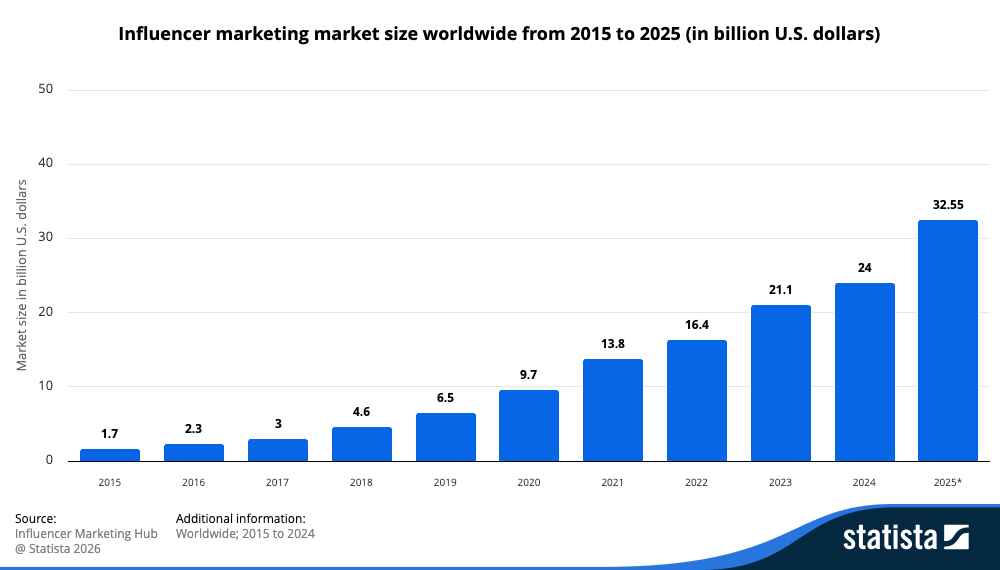
Source: Statista (2026), based on data from Influencer Marketing Hub. The 2025 figure is a projection.
Building a Connection
What makes influencer marketing so fruitful? The keys to an effective influencer collaboration are alignment and authenticity.
Aligning the Brand
The brand should align their chosen influencer with the brand’s values, goals, and audience. For example, Bud Light’s 2023 collaboration with TikTok influencer and transgender advocate Dylan Mulvaney did not align well with Bud Light’s more conservative consumer audience. As a result, many US consumers boycotted the brand, and the company saw a 10% sales decrease as well as a minimum of a 5% share value decrease in the US market. Picking the right influencer can be the deciding factor between achieving minimal to overwhelming success or, in Bud Light’s case, achieving positive or negative returns.
The Charli Cold Brew
In 2020, Dunkin’ Donuts launched a collaboration with Tiktok influencer phenomenon Charli D’Amelio. On the campaign launch day, Dunkin’ Donuts saw a 57% increase in its application downloads in comparison to its 90-day average. The collaboration also impacted its long-term loyalty campaign, where the company stated that the week of the Charli-Dunkin’ launch saw the second highest increase in its loyalty program sign-ups. While exact revenue values were omitted from the public, sales increased significantly due to the launch, with a 20% sales boost of all cold brew coffees on launch day and a 45% increase of all cold brew sales the day after the launch.
Some could argue that Charli’s high TikTok follower count was the factor in the traffic increase, but the authenticity of the collaboration was a driving factor in these positive statistics for Dunkin’ Donuts. Jill Nelson, Dunkin’ Donuts’ VP of marketing strategy, stated that the partnership evolved organically after Charli regularly shared her love for the Dunkin’ Donuts brand on social media. D’Amelio consistently demonstrated that she loved Dunkin’ Donuts, reinforcing the authenticity factor of an influencer collaboration.
Authenticity: Real or Fake?
“Authenticity is the basis of any successful influencer marketing campaign” (McKinsey, 2023). Authenticity is the root of trust and credibility, and it allows brands to foster strong relationships with their audiences. Research suggests that authenticity is defined by five core properties:
- Expertise applies when the influencer is considered an authority in their field. Picking the right influencer plays an important role with the expertise property; a skincare influencer promoting skincare brands is perceived as an expert because they have proven that skincare is what they are all about.
- Connectedness refers to the emotional relationship between the influencer and the audience. An influencer portrays high connectedness if followers feel engaged and transformed by the influencer’s actions.
- Originality measures the uniqueness of an influencer's content, specifically how they use storytelling and personal experiences to shape their work.
- Transparency reflects how openly an influencer communicates with their audience. The rise of artificial intelligence is topical; research has shown that influencers’ transparency about AI’s role in content creation can strengthen their credibility among audiences.
- Integrity is the consumers’ perception of influencers' incentives, where they look for intrinsic motivation instead of financial interest. Consumers will believe that influencers are passionate about the brand and that they have their audiences’ best interests at heart.
Authenticity creates long-term relationships between the influencer, the brand, and the audience. Although not all five properties need to be achieved for an influencer collaboration to be perceived as genuine, an authentic endorsement allows them to easily sway their consumers’ purchasing decisions.
Marketing Evolution
The digitization of marketing is integral in understanding why influencer marketing is so impactful today. The rise of big data, smartphones, and most importantly, the internet are the catalysts in moving traditional marketing towards digital marketing.
Traditional marketing uses offline channels to target audiences, and it targets individuals when they are away from the internet. These can include print ads, billboards, radio ads, and television commercials. In comparison, digital marketing relies on online channels such as search engine optimization, social media marketing, email marketing, and content marketing. As of October 2026, 6.15 billion people were internet users, representing 73.8% of the global population. 5.81 billion people are social media users, and this value is projected to increase by 200 million every year until 2040. This digital saturation can be attributed to the early successes of search engine browsers such as Google, e-commerce sites such as Amazon, and technological powerhouses such as the iPhone. The upward trend of internet and social media users outlines the emerging relevance of social media and digital platforms, emphasizing the importance of digital marketing.
Generation Z
Individuals born between 1997 and 2012, otherwise known as Gen Z, are an important factor in digital marketing. Gen Z, the first generation to grow up with the internet, is defined as the ‘digital native’ generation. Online advertising experiences high exposure with this generation, as 16-24 year-old Gen Z individuals spend over 2/3 of their media time with digital channels (such as messaging platforms and mobile apps). In addition, Gen Z consumers are highly influenced by social media. 41% of Gen Z rely on social media platforms first for information instead of traditional search engines, and this generation accounted for 53% of global social media shoppers in 2024. Gen Z accounts for most online shopping and social media audiences, which means Gen Z is a significant target audience in digital marketing.
The Gen Z generation represents a significant portion of the current population, accounting for a projected 19.3% of the Canadian population as of July 2026. Digital marketing efforts targeted towards Gen Z values can reach a growing market as Gen X and baby boomers age out of the workforce. It is important to note that in 2023, Gen Z accounted for 25% of the workforce. As more of Gen Z enter the workforce, their spending power and their financial impact will grow.
The Impact on Influencer Marketing
The combination of digital marketing and the Gen Z population has a positive impact on influencer marketing. Gen Z is recognized for their social awareness, and this generation prioritizes authenticity, transparency, and social awareness. As mentioned previously, a successful influencer collaboration conveys authenticity.
Forbes (2023) iterates that Gen Z is an influencer generation who wants to see people and brands they respect, and that social media and influencer marketing strategies can work effectively for Gen Z audiences. Influencer marketing works with Gen Z because influencers flood social media, and Gen Z consumes social media constantly. They are a generation that can be influenced considerably by the content on their feeds, so influencer collaborations can take advantage of the time spent on social media and the information they absorb.
In a marketing sense, this is an opportunity to take advantage of, and what makes a growing population tick. Focus on targeting the digital channels in a digital era, and consider the significant online Gen Z presence. Importantly, always consider what is best for the brand; if the brand appeals better to another generation, stay the path.
How valuable can clout truly be?
Influencer marketing is unique because it monetizes passion. In order to create successful influencer campaigns, it is important to pick the right influencer for the brand. Consider the influencer’s audience, personality, values, and how well they align with the brand. Remember that authenticity is the selling factor. If consumers do not believe that the influencers believe in the brand, why should they? Consumers can recognize fraudulence, and an authentic connection means consumers will trust someone over the longterm. Marketing is all about creating value for the customer, and there is no better way to create value than through trust.
References
Bardon, A. (2025, March 20). The power of influencer marketing in the digital age | Lindenwood University. Lindenwood University. https://www.lindenwood.edu/blog/the-power-of-influencer-marketing-in-the-digital-a ge/
BBC News. (2023, August 3). Bud Light Boycott over trans influencer Dylan Mulvaney hits beer giant’s sales. BBC News. https://www.bbc.com/news/business-66398296
Champlain College Online. (2026, February 27). Traditional marketing vs. digital marketing: What’s the difference? Champlain College Online. Champlain.Edu. https://online.champlain.edu/blog/traditional-marketing-vs-digital-marketing
Chevalier, S. (2022, October 20). Share of shoppers who had purchased a product directly from a social media platforms worldwide in 2022, by generational cohort. Statista. https://www.statista.com/statistics/1273928/share-social-buyers-age-group-worldwide
Digital Marketing Institute. (2016, October 4). The-evolution-of-digital-marketing-30-years-in-the-past-and-future. Digital Marketing Institute. Digital Marketing Institute. https://digitalmarketinginstitute.com/blog/the-evolution-of-digital-marketing-30-years -in-the-past-and-future
Drenik, G. (2023, July 13). Gen-Z 101: A marketing guide to connecting with the next generation of consumers. Forbes. https://www.forbes.com/sites/garydrenik/2023/07/13/gen-z-101-a-marketing-guide-to connecting-with-the-next-generation-of-consumers/
Frew, H. (2025, February 21). New research explores authenticity in influencer marketing - office of the provost. Office of the Provost. https://provost.gsu.edu/2025/02/21/influencer-marketing/
McKinsey. (2024, August 28). What is gen Z? McKinsey & Company. https://www.mckinsey.com/featured-insights/mckinsey-explainers/what-is-gen-z
McKinsey & Company. (2023, April 10). What is influencer marketing? Mckinsey & Company. https://www.mckinsey.com/featured-insights/mckinsey-explainers/what-is-influencer marketing
Moreton, G. (2022, October 21). BITE trend | gen Z: World’s most digital generation. Creativebrief. https://www.creativebrief.com/bite/trend/gen-z-worlds-most-digital-generation
Petrosyan, A. (2025, April 1). Number of internet and social media users worldwide as of february 2025. Statista. https://www.statista.com/statistics/617136/digital-population-worldwide/
Pinkerton, L. A. (2022, March). The power of influencer marketing. PRSA. https://www.prsa.org/article/the-power-of-influencer-marketing
Population Pyramids. (2026). Canada generation populations 2026. Populationpyramids.Org. https://www.populationpyramids.org/generations/canada
Rogers, K. (2020, October 23). Dunkin” is keeping beverage innovation humming during the pandemic as consumers look to treat themselves. CNBC. https://www.cnbc.com/2020/10/23/dunkin-is-keeping-beverage-innovation-humming during-covid-pandemic.html
Ross, C. (2025, March 21). Influencer marketing market size worldwide from 2015 to 2025. Statista. https://www.statista.com/statistics/1092819/global-influencer-market-size/
Statista. (2026, September 26). Number of social media users worldwide 2040. Statista. https://www.statista.com/statistics/454772/number-social-media-user-worldwide-regi on/
StatSocial. (2025, April 11). An Influencer Attribution Case Study: Dunkin’ and Charli D’Amelio. StatSocial. https://www.statsocial.com/blog/charli-damelio-dunkin-influencer-attribution/
Strong, J. (2026). TIME100: The most influential people of 2026. 2026 replatform. TIME. https://time.com/collection/100-most-influential-people/2026/
Target Internet. (2024). How different age groups are using social media 2024. Target Internet. https://targetinternet.com/resources/how-different-age-groups-are-using-social-media 2024/


