
In seemingly ordinary objects, the collection of information has become significantly easier. These concerns have led to cybersecurity evolving from protecting IT systems to protecting the foundations of businesses today.
Written by Elysia Sokoine, Ottawa, November 10, 2026
“Cover your laptop cameras; they can see you.” From childhood games and harmless warnings to the simple action of opening your laptop, we have long been warned our data is within reach of anyone truly looking for it. As the world has evolved, these warnings have become increasingly relevant in a way we didn't quite expect. In seemingly ordinary objects, the collection of information has become significantly easier. These concerns have led to cybersecurity evolving from protecting IT systems to protecting the foundations of businesses today.
While technological advancement in smart devices and AI-powered tools has simplified everyday functions, it has also opened the door to countless cyber threats and attacks. Users often don’t realize manufacturers prioritize convenience over security. How many users can confidently say they read the terms and conditions? On the other hand, small and large businesses alike take privacy and security far more seriously. It is no longer exclusively personal information that is accessible but multimillion-dollar plans and profit at risk too.
Maintaining the interconnectedness between worldwide businesses, suppliers, and employees is reliant on the digital storage of data and movement of it. It is unproductive and unideal to continue relying on the physical storage of data. Cloud-based and digital systems encourage collaboration among employees, store intellectual property, financial information and other sensitive information that serves as valuable company assets. The trade-off of having an efficient business process is the attraction of cybercriminals and a loss of competitive advantage.
To keep up, companies must race to adopt the very same AI technology that may be the reason for their downfall, and not all are prepared for this given the ever-changing threat landscape.
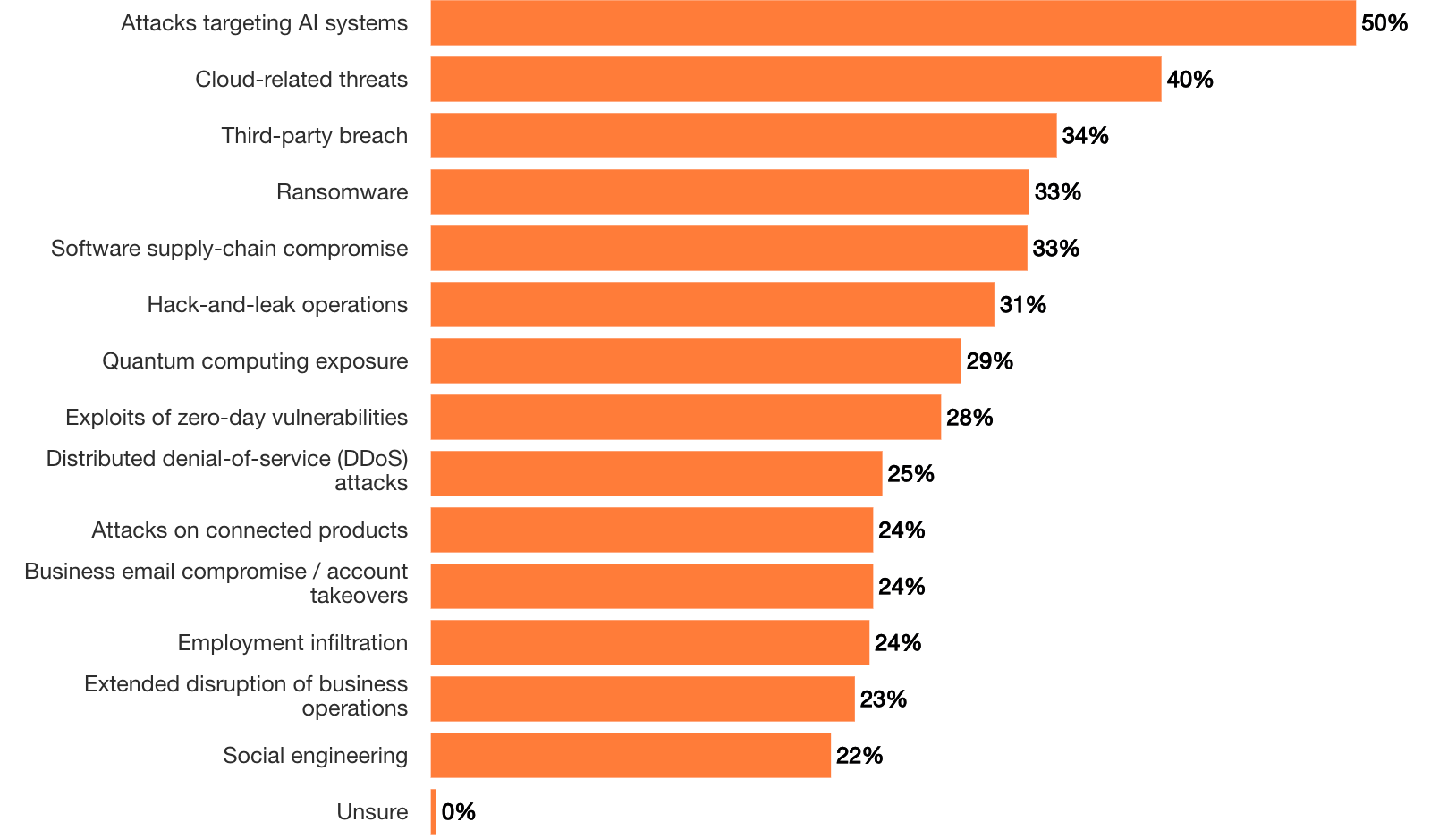
Graph showing the cybersecurity threats organizations are least prepared to address in the next 12 months (PwC, 2026).
AI-enabled threats now exploit vulnerabilities faster at a larger scale with a greater autonomy. As a result, businesses are expected going into 2027 to stretch their cybersecurity budgets thinner to cover this new digital era. In 2025 alone, expenditure in this sector increased by 12% (Clark O’Niell et al., 2026).
The Consequences and Future of Cybercrime
An attack doesn’t end when a company’s access is regained. Prevalent methods such as phishing, ransomware, theft of intellectual property and so on damage the reputation of a company. The major outcome of this is loss of profit, existing capital, funding and vital networks or investors. Consider, for instance, the cyberattacks on several US hedge funds including Citadel and Point72 in August 2026. Through phishing, weaknesses were exploited for malicious intent via impersonation of employees, permitting access to sensitive information, according to the Financial Times. While established firms can withstand a breach of trust, for a smaller emerging business, the damage would be far worse.
Today, the digital economy is many companies' greatest asset. This profitable asset is a major worry as cyber tools improve and companies adopt them to stay ahead of their competitors. The question is no longer how much a business can invest in cybersecurity, but whether it can afford the consequences of neglecting it.
References
Clark O’Niell, Troha, C., Lyon, V., Chen, A., Chopra, S., Jain, I., Asen, A., & Mitchell, S. (2026, August 27). Cybersecurity budgets are growing fast. AI threats are growing faster. BCG Global. https://www.bcg.com/publications/2026/cybersecurity-spending-ai-threat-trends
CSIS. (2025). Significant Cyber Incidents. Center for Strategic and International Studies. CSIS. https://www.csis.org/programs/strategic-technologies-program/significant-cyber-incidents
Fotis, F. (2024). Cyberattacks: Economic impacts and risk management strategies. 15th International Conference on Emerging Ubiquitous Systems and Pervasive Networks / 14th International Conference on Current and Future Trends of Information and Communication Technologies in Healthcare EUSPN/ICTH 2024, 251, 672–677. https://doi.org/10.1016/j.procs.2024.11.167
Gallant, B. (2025, February 14). The cybersecurity threats of IoT devices. Adaptive Office Solutions. https://www.adaptiveoffice.ca/blog/the-cybersecurity-threats-of-iot-devices/PricewaterhouseCoopers.
PwC. (2026, October 1). Moving targets: Cybersecurity in a dynamic digital world. PwC. https://www.pwc.com/us/en/services/consulting/cybersecurity-data-tech-risk/library/gloal-digital-trust-insights.html
Statistics Canada. (2024, October 21). The daily — Impact of Cybercrime on Canadian businesses. StatsCan. https://www150.statcan.gc.ca/n1/daily-quotidien/241021/dq241021a-eng.htm


